

Autonomous Trucks Market Expanding at a CAGR of 20.5% By Growing Demands, Trends and Industry Foresight Till 2035
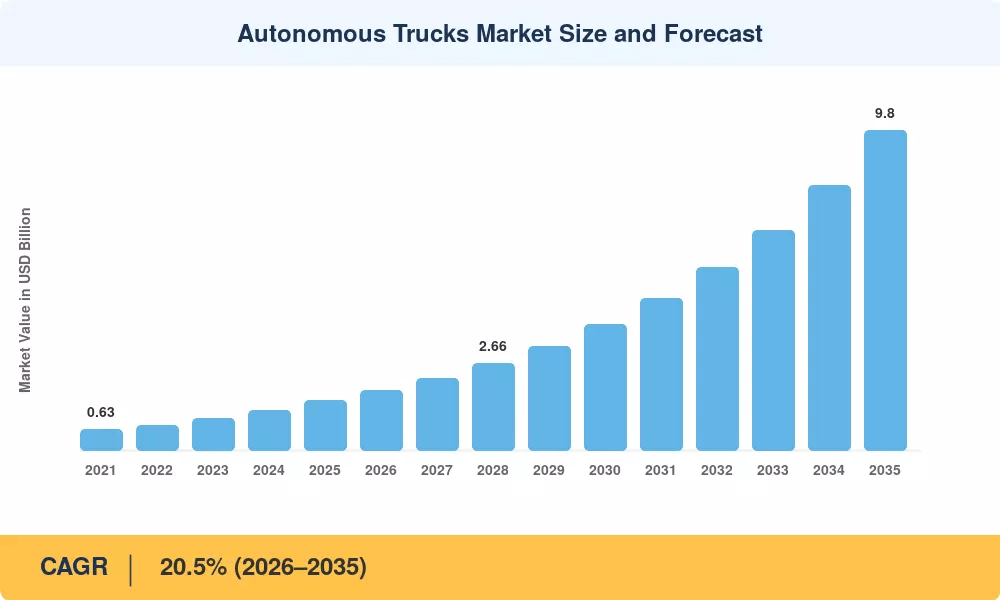
Autonomous Trucks Market Summary
Long-haul freight and logistics represent the largest application of the Autonomous Trucks Market, capturing roughly 64% share.
Level 4 systems dominate the Autonomous Trucks Market with approximately 58% revenue share in 2025, reflecting the hub-to-hub highway operating model favored by commercial fleets.”
NY, CA, UNITED STATES, July 14, 2026 /EINPresswire.com/ -- Autonomous trucks are commercial heavy-duty vehicles equipped with advanced sensor systems, artificial intelligence, and control technologies that enable them to navigate and operate on roadways with partial or full autonomy. These vehicles integrate a sophisticated suite of sensors, including cameras, LiDAR, radar, and GPS, with high-performance computing platforms that process real-time environmental data to execute driving decisions without direct human input. The autonomy spectrum ranges from Level 2 driver-assist features like adaptive cruise control and lane-keeping to Level 4 highway autonomy where trucks operate without a human driver within defined operational domains, and ultimately Level 5 full autonomy capable of navigating any road under any conditions . These vehicles are designed to address chronic driver shortages, improve fuel efficiency, enhance safety, and reduce operational costs across the logistics sector.— Arti Dhapte
Autonomous Trucks Market Overview
The autonomous trucks market share is positioned for extraordinary growth through 2035, driven by chronic driver shortages, technological maturation, and the convergence of regulatory and economic catalysts. The projected valuation of USD 9.80 billion, growing at a robust CAGR of 20.5%, reflects the commercial transition from controlled pilots to revenue-generating operations across major global corridors.
The market is experiencing explosive growth driven by several fundamental factors. The chronic driver shortage is the single strongest catalyst—the American Trucking Associations estimated a shortage of 82,000 drivers in 2024, a figure projected to exceed 160,000 by 2031 if demographic trends hold . Driverless operations eliminate the single largest variable cost in over-the-road freight, as average driver compensation has risen approximately 25% since 2019, compressing carrier margins on long-haul lanes. The U.S. Federal Motor Carrier Safety Administration's evolving framework for automated driving system-equipped commercial vehicles and over USD 12 billion in cumulative venture and strategic investment directed at self-driving truck developers between 2020 and 2025 further accelerate the transition . The growth of e-commerce and freight volume, combined with compressed delivery windows, directly accelerates fleet adoption to maximize operational capacity.
Industry trends indicate a decisive shift from controlled-track testing to continuous revenue-generating operations on designated highway corridors. The U.S. Department of Transportation's AV 4.0 policy framework and European Commission's updated General Safety Regulation provide regulatory frameworks that did not exist five years ago . The adoption of hub-to-hub transfer models, where autonomous trucks operate between strategically located terminals while human drivers handle first- and last-mile legs, reduces regulatory complexity and enables rapid geographic scaling . The convergence of battery-electric drivetrains and autonomous control creates a compounding value proposition—driverless electric trucks can operate continuously at low marginal energy cost, aligning with zero-emission fleet mandates .
Technological developments are rapidly advancing the capabilities and economics of autonomous trucks. Sensor stack costs are declining significantly as mass production of critical hardware lowers entry barriers, reducing fleet equipment costs . The development of foundation models trained on billions of driving miles is replacing hand-coded rule sets in perception stacks, enabling trucks to predict and react to novel highway scenarios with human-equivalent or better reliability . Generative world-models and high-fidelity simulation environments allow developers to test billions of virtual miles against edge-case scenarios before road deployment, accelerating validation timelines by roughly 10x compared with physical road testing alone . Digital twin technology enables continuous validation and software improvement without physical deployment, while cloud-based fleet management platforms optimize routing and logistics.
Policy and regulatory influence on the autonomous trucks market is profound and evolving. Texas, Arizona, New Mexico, and Florida now permit driverless heavy-vehicle operations on designated highway corridors without a safety driver on board . At the federal level, FMCSA's 2024 Advance Notice of Proposed Rulemaking on ADS-equipped commercial motor vehicles signals a path toward national standards . Germany's 2022 Autonomous Driving Act created the world's first comprehensive legal basis for Level 4 commercial-vehicle operations on public roads . The European Commission's updated General Safety Regulation mandates advanced driver-assistance systems, creating a bridge toward higher autonomy . China is investing over USD 2.5 billion in smart-highway infrastructure along the Beijing-Tianjin-Hebei corridor and the Yangtze Delta, creating purpose-built environments for autonomous trucks .
The demand outlook remains exceptionally strong. North America holds the largest share of the autonomous truck market, accounting for over 42% of global revenue, driven by favorable state-level laws and severe driver shortages . Asia-Pacific is the fastest-growing region with a projected CAGR of 23.8%, driven by investments in smart-logistics infrastructure from China and Japan . Europe accounts for about 28% of the market, with pan-European corridor pilots and Germany's Autonomous Driving Act leading regulatory adoption . Industry analysis estimates a 30–45% per-mile cost reduction on routes exceeding 500 miles from eliminating driver wages and enabling near-continuous utilization, with payback on the hardware premium typically occurring within 18–24 months .
📍 Get Free Sample Report for Detailed Market Insights:
https://www.marketresearchfuture.com/sample_request/6126
Autonomous Trucks Market Segmentation
By Autonomy Level
The autonomous trucks market is segmented by autonomy level into Level 2/3 (Driver-Assist), Level 4 (Highway Autonomy), and Level 5 (Full Autonomy). Level 4 systems dominate the market with approximately 58% revenue share in 2025, reflecting the hub-to-hub highway operating model favored by commercial fleets . Level 4 systems operate within a defined operational design domain that avoids complex urban intersections, enabling repeatable driverless operations on interstate corridors . Level 2/3 platforms account for an estimated USD 0.52 billion and serve as bridge technologies in mixed-fleet environments, with incumbent OEMs integrating advanced driver-assistance capabilities across standard production models . Level 5 full autonomy remains pre-commercial but is projected to register the highest segment CAGR of 28.4% through 2035, reflecting anticipated breakthroughs in AI perception and redundancy architecture .
By Application
Application segmentation covers Long-Haul Freight & Logistics, Mining & Off-Highway, Port & Terminal Operations, and Last-Mile & Urban Delivery. Long-haul freight and logistics represent the largest application, capturing roughly 64% share, where the economic case is strongest for eliminating driver wages on routes exceeding 500 miles . Mining and off-highway applications are growing at a CAGR of 18.7%, with companies like Caterpillar having operated autonomous haul trucks in open-pit environments for over a decade . Port and terminal operations contribute USD 0.09 billion in 2025, driven by turnaround-time reduction needs . Last-mile and urban delivery are projected to grow at the fastest CAGR of 24.2%, fueled by e-commerce volume growth and the need for efficient urban logistics .
By Propulsion Type
Propulsion type segmentation includes Diesel/CNG, Battery-Electric, and Hydrogen Fuel Cell. Diesel-powered platforms currently dominate with 71% share, as the first generation of driverless systems was integrated onto existing diesel Class 8 tractors . Battery-electric autonomous trucks are the fastest-growing segment at 26.3% CAGR, driven by zero-emission mandates including California's Advanced Clean Fleets rule requiring 100% zero-emission drayage by 2035 . Hydrogen fuel cell represents USD 0.04 billion in 2025, targeting long-range heavy-duty applications where battery-electric range remains limited .
By Region
Regional segmentation includes North America, Europe, Asia-Pacific, South America, and the Middle East and Africa. North America leads with a 42% share, underpinned by corridor-specific state permits. Asia-Pacific is expanding at a CAGR of 23.8%, driven by government-backed logistics modernization. Europe's share stands at 28%, with Germany and the Netherlands leading regulatory adoption.
🛒 You can buy this market report at:
https://www.marketresearchfuture.com/checkout?currency=one_user-USD&report_id=6126
Autonomous Trucks Market Competitive Landscape
The autonomous trucks market exhibits moderate concentration, with the top five technology developers and OEM partnerships commanding an estimated 45–55% of global revenue . The competitive landscape is reshaping as partnerships between technology stacks and truck manufacturers create integrated, vertically aligned offerings. Key players include Aurora Innovation, Waymo Via, Kodiak Robotics, Daimler Truck (Torc), TuSimple, Plus (PlusAI), Volvo Autonomous Solutions, PACCAR, Inceptio Technology, and Caterpillar .
Aurora Innovation (10-14% share) offers the Aurora Driver platform with Volvo/PACCAR integration, employing a platform-first, multi-OEM strategy . Waymo Via (8-12% share) leverages technology scales from passenger AV to Class 8 chassis through the Waymo Driver . Kodiak Robotics (6-9% share) pursues commercial and government dual-use with the Kodiak Driver and U.S. defense contracts . Daimler Truck (7-10% share) offers Torc autonomous Freightliner Cascadia as a vertically integrated OEM solution . Plus (PlusAI) (5-8% share) provides the PlusDrive retrofit kit as a cost-accessible fleet retrofit option .
Strategic developments include Volvo Group and Waabi establishing a strategic partnership in February 2025 to integrate Waabi's virtual driver system directly into Volvo VNL Autonomous trucks at the factory level . PepsiCo and Gatik announced a multi-year commercial agreement in June 2026 to deploy fully autonomous middle-mile freight operations across PepsiCo's North American logistics network . Volvo and Aurora launched a new 200-mile autonomous freight route between Dallas and Oklahoma City in May 2026 to expand commercial driverless trucking networks .
Latest Industry News & Developments
Recent industry developments highlight the accelerating commercialization of autonomous trucks. In February 2025, Volvo Group and Waabi established a strategic partnership to integrate Waabi's virtual driver system directly into Volvo VNL Autonomous trucks at the factory level, representing a significant OEM-technology developer integration . In June 2026, PepsiCo and Gatik announced a multi-year commercial agreement to deploy fully autonomous middle-mile freight operations across PepsiCo's North American logistics network, demonstrating enterprise-scale commitment to autonomous logistics . In May 2026, Volvo and Aurora launched a new 200-mile autonomous freight route between Dallas and Oklahoma City to expand commercial driverless trucking networks .
The U.S. Federal Motor Carrier Safety Administration issued an Advance Notice of Proposed Rulemaking on ADS-equipped commercial motor vehicles in 2024, signaling a path toward national standards . Germany's Autonomous Driving Act and the European Commission's updated General Safety Regulation continue to provide regulatory frameworks for deployment . The California Air Resources Board's Advanced Clean Fleets rule is pushing zero-emission targets to 2032, creating dual procurement incentives for battery-electric autonomous trucks .
Autonomous Trucks Market Challenges & Opportunities
Key restraints facing the autonomous trucks market include a fragmented regulatory landscape, with most jurisdictions worldwide lacking clear legal frameworks for driverless commercial vehicles . High upfront capital requirements—equipping a Class 8 tractor with a production-ready autonomous stack costs between USD 60,000 and USD 100,000 above a conventional vehicle—create adoption barriers for smaller carriers . Public perception and liability concerns, cybersecurity vulnerability exposure, and workforce displacement opposition from major unions advocating for mandatory human-operator requirements further constrain growth . Sensor and compute kit costs, while declining, remain significant investments that limit immediate procurement capabilities to well-funded Tier-1 fleets .
Emerging opportunities are substantial and diverse. Middle-mile and transfer-hub network expansion enables rapid geographic scaling, with operators like Kodiak Robotics demonstrating this model across 10 U.S. states . The electrification-autonomy convergence creates compounding value, with battery-electric autonomous trucks achieving the lowest per-mile cost structure when operating continuously . Data monetization and Freight-as-a-Service models allow technology developers to monetize operational data through licensing to municipalities, infrastructure agencies, and mapping companies . Emerging-market mining and resource corridors in Australia, Chile, and South Africa present growth vectors with proven safety and productivity gains of 15–20% over manned fleets . Port and intermodal terminal automation, driven by global container port traffic reaching 920.3 million TEUs, creates replicable blueprints for deployment.
Future potential lies in AI-driven perception and decision systems, with generative world-models enabling trucks to predict and react to novel highway scenarios with human-equivalent reliability by 2030 . Platform economics and freight marketplaces will integrate driverless capacity into real-time spot and contract marketplaces, shifting economics from capital expenditure to operating expenditure . The convergence with electrification and zero-emission mandates creates dual procurement incentives, particularly in California and Europe. Safety data and regulatory confidence cycles will accelerate as each additional million miles of driverless commercial operation generates actuarial data that feeds insurance models, lowers premiums, and builds regulatory confidence for expanded corridor approvals .
To explore more market insights, visit us at:
https://www.marketresearchfuture.com/reports/autonomous-trucks-market-6126
The medium-term growth outlook remains exceptionally strong, supported by state-level permits in the US, Germany's Autonomous Driving Act, and China's smart-highway investments. North America will continue to lead in revenue terms, while Asia-Pacific presents the fastest growth at 23.8% CAGR driven by government-backed logistics modernization . The economic case is compelling, with industry analyses estimating a 30–45% per-mile cost reduction on long-haul routes and payback on hardware premiums occurring within 18–24 months .
Long-term industry potential extends well beyond the current forecast horizon, as the convergence of AI-driven perception, electrification mandates, and data monetization models reshapes freight logistics. The shift toward Truck-as-a-Service models will lower adoption barriers and expand market access . The virtuous cycle of safety data generation, regulatory confidence, and insurance premium reduction will accelerate deployment corridors . Companies that successfully build large mileage databases, form strategic OEM partnerships, and develop integrated technology-platform business models will capture disproportionate value. As autonomous trucks transition from technological novelty to essential logistics infrastructure, they will fundamentally reshape the economics and environmental footprint of global freight movement.
More Related Reports from MRFR Library:
https://www.marketresearchfuture.com/reports/electric-axle-drive-systems-market-4082
https://www.marketresearchfuture.com/reports/automotive-braking-system-market-4166
https://www.marketresearchfuture.com/reports/3d-printing-automotive-market-4207
https://www.marketresearchfuture.com/reports/automotive-artificial-intelligence-market-4258
https://www.marketresearchfuture.com/reports/automotive-fleet-leasing-market-4328
https://www.marketresearchfuture.com/reports/automotive-ahss-market-4648
https://www.marketresearchfuture.com/reports/automotive-engine-management-system-market-4752
https://www.marketresearchfuture.com/reports/automotive-powertrain-systems-market-4793
https://www.marketresearchfuture.com/reports/electric-vehicles-battery-market-4810
https://www.marketresearchfuture.com/reports/automotive-pressure-sensor-market-4906
Larry Wilson
WantStats Research And Media Pvt. Ltd.
+1 855-661-4441
email us here
Visit us on social media:
LinkedIn
Facebook
YouTube
X
Legal Disclaimer:
EIN Presswire provides this news content "as is" without warranty of any kind. We do not accept any responsibility or liability for the accuracy, content, images, videos, licenses, completeness, legality, or reliability of the information contained in this article. If you have any complaints or copyright issues related to this article, kindly contact the author above.
